AP Human Geography (Period 1,2,3) Assignments
- Instructor
- Jerry Knox
- Term
- Spring 2019
- Department
- Social Science
Upcoming Assignments

No upcoming assignments.
Past Assignments
Due:
ec
Due:
ec
Due:
ec
Due:
ec
Due:
ec
Due:
ec
Due:
ec
Due:
Assignment
Due:
Assignment
The AP Human Geography test begins at 1pm.
The online AP Exam is optimized for use in the latest versions of Chrome (preferred), Firefox, Safari, and Microsoft Edge. The online exam won't be compatible with Internet Explorer 11.
Due:
class notes
Due:
Models review.
Due:
2020 test format
|
Exam timing |
Students will have 25 minutes to read and respond to Question 1, and then 5 minutes to upload their response. After uploading the response to Question 1, students will have 15 minutes to respond to Question 2, with 5 additional minutes to upload their response to Question 2. Once their response to Question 1 has been submitted, they cannot go back to it. |
|
|
Questions |
Question 1 (25 mins.) |
Question 2 (15 mins.) |
|
% of exam weight (rounded) |
55% |
45% |
|
Question name |
Two-Stimulus Free-Response Question |
One-Stimulus Free-Response Question |
|
Question description |
Question 1 presents students with an authentic geographic situation or scenario and assesses students’ ability to describe, explain, and apply geographic concepts, processes, or models, as they analyze geographic patterns, relationships, and outcomes in applied contexts. Question 1 includes 2 stimuli (data, images, and/or maps). |
Question 2 presents students with an authentic geographic situation or scenario and assesses students’ ability to describe, explain, and apply geographic concepts, processes, or models, as they analyze geographic patterns, relationships, and outcomes in applied contexts. Question 2 includes 1 stimulus (data, image, or map). |
|
Corresponding free-response question (FRQ) type in the course and exam description binder |
FRQ 3
|
FRQ 2
|
Due:
Topics that have not been an FRQ yet
I Geography: Its Nature and Perspectives
Populations grow and decline over time and space.
Evaluate various national and international population policies.
Analyze reasons for changes in fertility rates in different parts of the world.
III. Concepts of culture frame the shared behaviors of a society.
Explain how globalization is influencing cultural interactions and change.
Compare and contrast ethnic and universalizing religions and their geographic patterns.
Explain the concepts of political power and territoriality.
V Agriculture, Food Production, and Rural Land Use
The development of agriculture led to widespread alteration of the natural environment
Explain the connection between physical geography and agricultural practices.
Analyze the economic forces that influence agricultural practices.
Evaluate the environmental consequences of agricultural practices.
Explain issues related to the changing nature of contemporary agriculture.
Explain issues related to the location of food-production facilities.
Due:
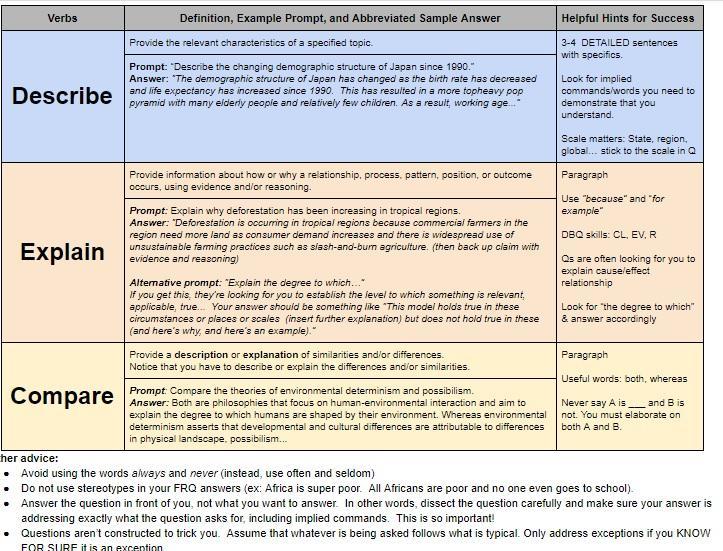
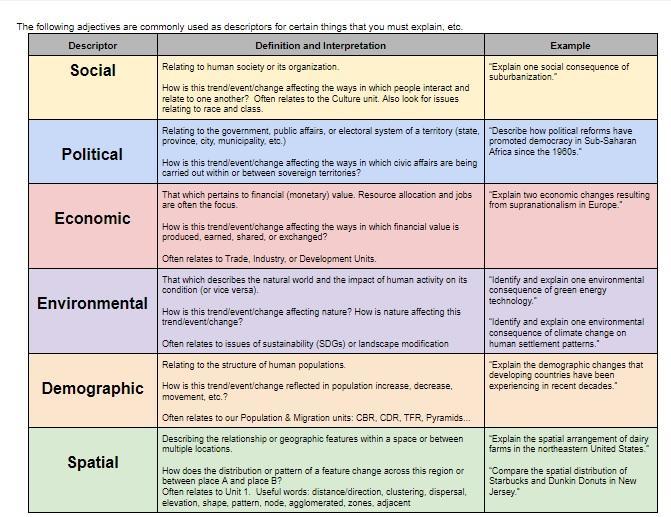
AP test help
Due:
Assignment
Due:
Assignment
Due:
Assignment
Due:
Course Content
ONLY UNITS 1-5 WILL BE ON THE HUMAN GEOGRAPHY TEST THIS YEAR: 2020
Unit 1: Thinking Geographically
Tools and methods geographers use in their study of places.
Topics may include:
Different types of maps and what they tell you
How geographers collect and use data
Spatial relationships and patterns
Data analysis at different scales (for example, global, national, local)
How geographers define regions
Unit 2: Population and Migration Patterns and Processes
Patterns associated with human populations.
Topics may include:
Population density and how it affects society and the environment
Theories of population growth and decline
Population and immigration policies and their effects
The causes and effects of migration
Unit 3: Cultural Patterns and Processes
How and why language, religion, and other cultural practices spread over space and time.
Topics may include:
The different ways that cultural practices spread
Historical forces, such as colonialism and trade, that affect cultural patterns
Modern forces, such as globalization, that affect cultural patterns
Why different religions spread in different ways
Unit 4: Political Patterns and Processes
Political organization of the world.
Topics may include:
Types of political entities such as nations and nation-states
The ideas and forces that shaped the political boundaries of the modern world
Forms of government such as unitary states and federal states
The factors that lead to states breaking apart
Unit 5: Agriculture and Rural Land-Use Patterns and Processes
Where humans first developed agriculture and how farming practices spread throughout the world.
Topics may include:
How physical geography influences farming practices
The origins and spread of agriculture
The Green Revolution
How farming practices affect the environment and society
UNIT 6 AND 7 WILL NOT BE ON THE TEST THIS YEAR
Unit 6: Cities and Urban Land-Use Patterns and Processes
The factors that drive the growth of cities and suburbs
Urban design initiatives and practices
Unit 7: Industrial and Economic Development Patterns and Processes
The Industrial Revolution
Economic sectors and patterns
How economic development affects the roles of women
Trade and the world economy
Due:
Assignment
Due:
Assignment
Due:
Assignment
- Physiological density
- What is the rate of natural increase?
- The epidemiological transition:
- Pronatalist policies, give one example.
- contraception
- assimilation
- Ethnic religion example
- Universalizing religions example
- Where are folk cultures often found?
- nation
- state
- autonomous regions
- What part of the world does the heartland theory believe is important to control?
- What part of the world does the rimland theory believe is important to control?
- organic theory?
- territoriality
- the Law of the Sea
- federal state
- State morphology
- What region is the Fertile Crescent found?
- Name one country in Southeast Asia?
- With regards to this class what was exchanged in the Columbian Exchange?
- What bioclimatic zone do we live in?
- Name 3 types of intensive farming:
- Name 3 types of Extensive farming:
- Overgrazing of land can lead to what environmental problem?
- aquaculture
- economies of scale
- What is an agricultural subsidy?
- Write what NAFTA stands for.
- site
- situation
- Compare and contrast popular and folk culture and the geographic patterns associated with each.
Due:
Tiny quiz
Due:
Practice FRQs
Due:
Assignment
Due:
Assignment
Due:
Course Content
ONLY UNITS 1-5 WILL BE ON THE HUMAN GEOGRAPHY TEST THIS YEAR: 2020
Unit 1: Thinking Geographically
Tools and methods geographers use in their study of places.
Topics may include:
Different types of maps and what they tell you
How geographers collect and use data
Spatial relationships and patterns
Data analysis at different scales (for example, global, national, local)
How geographers define regions
Unit 2: Population and Migration Patterns and Processes
Patterns associated with human populations.
Topics may include:
Population density and how it affects society and the environment
Theories of population growth and decline
Population and immigration policies and their effects
The causes and effects of migration
Unit 3: Cultural Patterns and Processes
How and why language, religion, and other cultural practices spread over space and time.
Topics may include:
The different ways that cultural practices spread
Historical forces, such as colonialism and trade, that affect cultural patterns
Modern forces, such as globalization, that affect cultural patterns
Why different religions spread in different ways
Unit 4: Political Patterns and Processes
Political organization of the world.
Topics may include:
Types of political entities such as nations and nation-states
The ideas and forces that shaped the political boundaries of the modern world
Forms of government such as unitary states and federal states
The factors that lead to states breaking apart
Unit 5: Agriculture and Rural Land-Use Patterns and Processes
Where humans first developed agriculture and how farming practices spread throughout the world.
Topics may include:
How physical geography influences farming practices
The origins and spread of agriculture
The Green Revolution
How farming practices affect the environment and society
UNIT 6 AND 7 WILL NOT BE ON THE TEST THIS YEAR
Unit 6: Cities and Urban Land-Use Patterns and Processes
The factors that drive the growth of cities and suburbs
Urban design initiatives and practices
Unit 7: Industrial and Economic Development Patterns and Processes
The Industrial Revolution
Economic sectors and patterns
How economic development affects the roles of women
Trade and the world economy
Due:
Assignment
- Listening to my review lectures that are located in the AP Human Geography Review on this webpage.
- Reading the AP Human Geography Review book that you purchased online.
- Reading your textbook.
- Reading p. 30-130 of the Course Framework provided by College Board (the company that makes the test): https://apcentral.collegeboard.org/pdf/ap-human-geography-course-and-exam-description.pdf
- Looking up terms and reading about topics you don't fully understand.
Due:
Assignment
Due:
Assignment
Due:
Assignment
Due:
Assignment
THURSDAY, APRIL 16th- How to Prepare for AP-Home Exams
Trevor Packer will be hosting a parent webinar to discuss this year’s at-home exams and how to help students prepare.
Due:
Assignment
https://www.prb.org/worldpopdata/
Due:
Assignment
Due:
Assignment
https://youtu.be/brkPOUiNMI4
Due:
Assignment
Due:
Assignment
Due:
Assignment
Due:
Assignment
these characteristics are common.
Due:
Assignment
Due:
Assignment
Due:
Assignment
Due:
Assignment
20 points
Create a birds eye view that incorporates new urbanism:
Walkable neighborhoods
Mixed use land use
Parks
Mixed income housing
Recreation facilities
Places of employment
Due:
Assignment
Due:
Assignment
Due:
Assignment
Due:
Assignment
Due:
Assignment
Place Marketing Project
Choose a city off the 101 freeway between the cities of San Jose and San Luis Obispo.
The city has hired you to bring tourism money to their city.
Create a unique atmosphere that will get people to stop and stay for a few hours or even a few days.
You will present this to the city council and the project that is chosen will receive 10 points extra credit.
Make a poster or brochure for 25 points.
Due:
Assignment
Due:
Assignment
Due:
Assignment
Due:
Assignment
Due:
Assignment
Due:
Assignment
Due:
Assignment
Due:
Assignment
Due:
Assignment
Due:
Assignment
Due:
Assignment
Due:
Assignment
Due:
Assignment
Due:
Assignment
Due:
